
Context and user
Duolingo is a language learning platform known for free, gamified lessons in over 40 languages. Its mission is to make language learning free, accessible and engaging, and its mascot, Duo the owl, is the face of that playful approach.
The user is anyone who wants to learn a language but is put off by cost, effort or dull teaching, including people traditional courses do not reach. It is strongest with beginners: it gets them started and builds solid foundations, though it does not replace immersive or high-level learning.
Problem
People who want to learn a language need a way to do it that is affordable, motivating and effective at scale. Traditional methods were difficult, time-consuming and expensive.
The core challenges: expensive courses and materials, low motivation and high dropout rates, little quality education for underserved populations, and teaching that was neither interactive nor effective.
What Duolingo built
How it removed the barriers
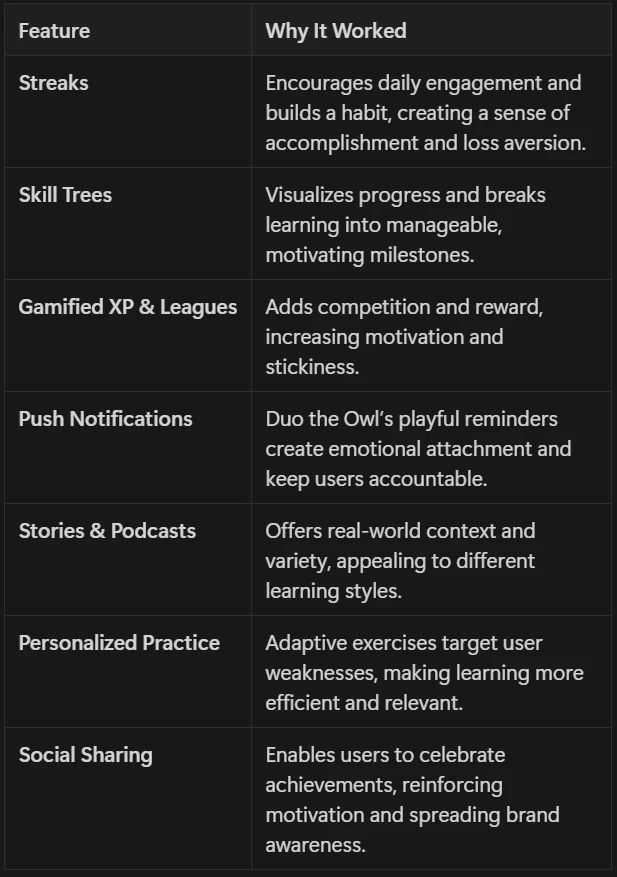
Which features do the work, and why
Competitive analysis
How Duolingo compares with three other language apps, as of May 2025.
| Feature | Duolingo | Babbel | Rosetta Stone | Memrise |
|---|---|---|---|---|
| Free tier | Yes | Limited | No | Yes |
| Gamification | Strong | Moderate | Minimal | Moderate |
| Languages offered | 40+ | 14 | 24 | 20+ |
| Mobile accessibility | Yes | Yes | Yes | Yes |
| Community features | Yes | Limited | No | Yes |
| Adaptive learning | Yes | Yes | Yes | Yes |
| Conversational focus | Limited | Strong | Moderate | Moderate |
Duolingo leads on language count (40+ vs Rosetta Stone ~25, Memrise 20+, Babbel 14) and gamification.
Gamification and the number of languages are where Duolingo stands alone. Mobile access and adaptive learning separate nobody, because all four have them. Conversation practice is locked behind Duolingo Max (Video Call and Roleplay), so free users get little real speaking practice. Babbel is more focused on conversation and grammar.
Strategy insights
Growth comes from the product itself. Users were drawn in by its engaging design and its effectiveness.
It keeps testing. Continuous A/B testing and analytics keep the app moving with what users need and prefer.
Freemium fits. The freemium model turned out to be the best model for Duolingo, because a free core removes the barrier to starting.
The brand is part of the product. Playful social media campaigns, witty notifications and Duo the owl’s persona made Duolingo recognisable.
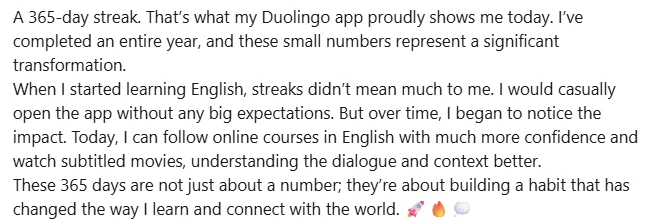
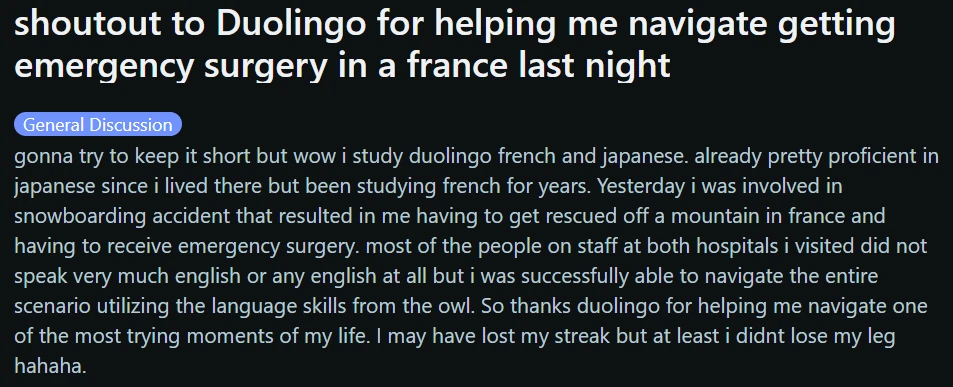
Users do the marketing. Word of mouth and user-generated content spread it further. One LinkedIn post about a 365-day streak calls it “building a habit that has changed the way I learn and connect with the world”, and a Reddit user credited “the language skills from the owl” with getting them through emergency surgery in France.
What I would do next
- Bring basic conversation practice to free users. Today AI conversation is a paid Duolingo Max feature, and it matters most to learners moving past the basics.
- Check that engagement and learning move together. A streak proves a learner came back, not that they improved, so I would track both.
- Interview learners who leave after the beginner stage. Public posts mostly come from the ones who stayed, which is a limit of this teardown.
What I learned
- Gamification can drive engagement and retention.
- Playful design and a distinctive brand voice can set a product apart in a crowded market.
- Continuous, data-driven improvement is what keeps a product relevant.
- Accessibility expands market reach.